)
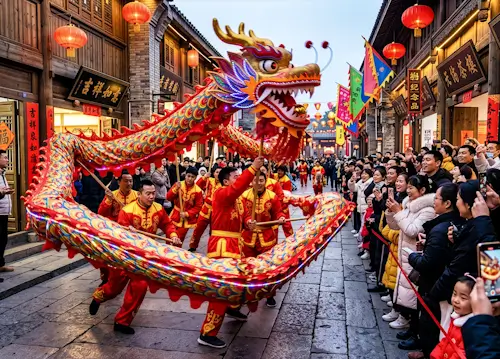
The crowd in today’s jigsaw puzzle is celebrating the Chinese New Year, otherwise known as the Spring Festival, which is a few months off, but I wanted to share this with you now.
I was fortunate enough to see a dragon dance on one of my visits to China. It’s the most important traditional holiday in Chinese culture.
The dragon symbolizes good luck and prosperity and control over nature, and the loud music, beating drums, and the dragon’s movements are meant to scare away evil spirits and bad luck.
It traditionally takes place before the new year begins.
During the Spring Festival, food serves as a tasty form of wordplay, where dishes are chosen because their names sound like wishes for wealth, health, and family harmony.
Fish (Yú) is the most crucial centerpiece because its name sounds identical to the Chinese word for surplus.
Families purposely leave a portion uneaten to ensure a continuous overflow of prosperity in the coming year.
For wealth, dumplings (Jiǎozǐ) and spring rolls (Chūnjuǎn) are staples.
Dumplings are shaped like ancient gold ingots, while fried spring rolls resemble gleaming gold bars; eating them symbolizes accumulating riches.
To invite personal and professional growth, people eat sticky rice cakes (Niángāo). The name sounds like “getting higher year by year,” representing promotions, better grades, or business success.
For dessert, sweet rice balls (Tāngyuán) are served in hot broth. Their round shape and pronunciation sound like “reunion,” celebrating family togetherness and unity.
Finally, longevity noodles (Cháng Shòu Màn) are served completely uncut—their unbroken length represents a long, healthy life.
Accompanied by tangerines, whose name sounds like “luck,” this festive feast is designed to taste delicious while welcoming an auspicious new beginning.
OK, on to today’s jigsaw puzzle!
Enjoy!
Chinese Dragon Dance – Thursday’s Jigsaw Puzzle
.